Mini vs Standard Excavator: Which One Your Job Actually Needs
Picking between a mini and a standard excavator is mostly about matching the machine to your site, not buying the biggest one you can afford. Get it wrong and you either can't fit through the gate or you're paying for power you never use. Here's how the two compare on the things that actually decide the job.
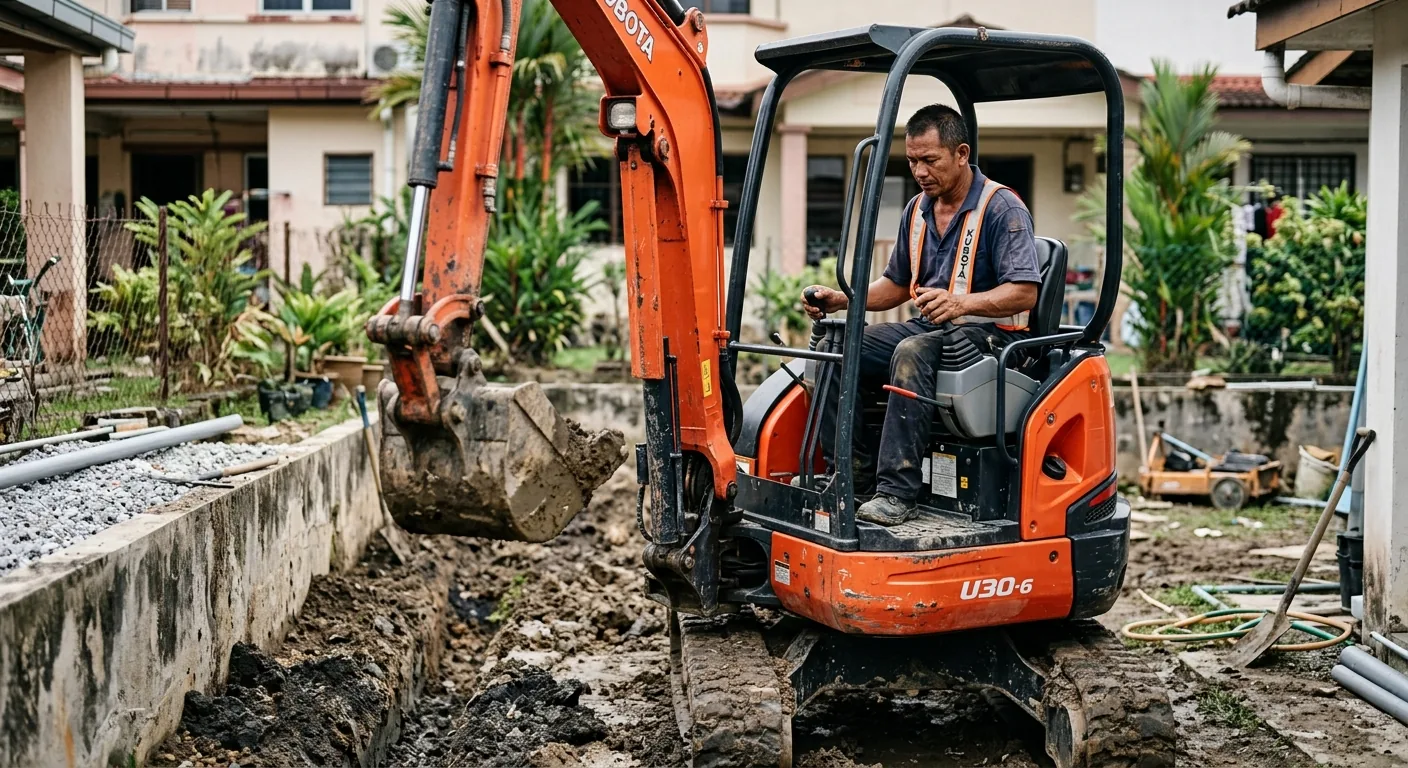
At a Glance
| Mini (1–5T) | Standard (7–20T) | |
|---|---|---|
| Operating weight | 1–5 tonne | 7–20 tonne |
| Daily rate | From RM800–1,200/day | From RM1,500–2,500/day |
| Site access | Excellent — fits tight lanes, gates and confined compounds | Needs open access and room to track and swing |
| Dig depth & reach | Shallower — roughly 2–3.5 m | Deeper — roughly 4–6.5 m and beyond |
| Productivity | Lower volume per hour — suits small, precise work | High volume — moves far more material per hour |
| Transport (mobilisation) | Light — cheaper to deliver on a small trailer | Heavier — needs a lowboy, higher mobilisation cost |
| Ground impact | Low ground pressure — gentle on finished surfaces | Higher ground pressure — can mark soft or finished ground |
| Best for | Drainage, landscaping, piping, confined residential earthworks | Construction, demolition, bulk earthworks and site formation |
Size and site access: the first thing that rules a machine out
The most common reason a job ends up on a mini excavator has nothing to do with digging — it's access. A mini in the 1–5 tonne class can pass through a standard single gate, work between two houses, and operate inside a walled compound without you having to knock anything down first. On terraced lots, back gardens, and existing developments, that's often the only realistic option.
A standard excavator in the 7–20 tonne range needs proper access: a wide entry, firm ground to track over, and clear space to swing the boom and load trucks. If the machine can't get in, or can't rotate once it's there, the extra power is wasted. Before you choose, measure your narrowest entry point and the working area — that single check decides more jobs than people expect.
If you're genuinely unsure, send us a photo of the access on WhatsApp and we'll tell you straight whether a mini fits or whether you need the bigger unit.
Digging power and depth: where standard pulls ahead
This is where the two classes separate clearly. A mini excavator handles soft to medium ground well, but it's built for finesse, not force. Realistic dig depth sits around 2–3 metres, and in hard or compacted soil it slows down. For drainage runs, footing trenches, and shallow excavation, that's plenty.
A standard excavator brings real breakout force and reach. It comfortably digs to roughly 4–6 metres depending on the model, pushes through rocky or compacted ground, and pulls apart structures during demolition. If your dig is deep, your soil is tough, or you're moving serious volume, the mini will simply struggle and cost you time.
Depth is also a safety issue. Deep trenches need the right machine and proper shoring — don't try to stretch a mini past what it's rated for just to save on the day rate.
Productivity: matching the machine to the volume
Day rate is only half the cost picture. The other half is how fast the job gets done. A standard excavator carries a much larger bucket and completes each dig-swing-dump cycle faster, so on a high-volume earthworks job it can move several times the soil a mini does in the same day.
That changes the maths. A mini at the lower day rate can end up more expensive overall if the job really wanted a bigger machine — because you're paying for three or four days of mini work to do what a standard finishes in one. For bulk excavation, site clearance, and earthworks, the standard usually wins on total cost even though its daily rate is higher.
The reverse is also true. On a small, fiddly, access-restricted job, a standard excavator is overkill — you'd pay more per day for capacity you can't use, and risk damaging the site on the way in.
Cost: day rate, packages, and the things people forget
As a rough guide, a mini excavator rents from around RM800–1,200 per day, while a standard sits from around RM1,500–2,500 per day. Those are starting ranges — the exact figure depends on the model, your location, and how long you need it.
A few costs sit outside the bare day rate. Most rentals price the operator separately, typically from around RM150–300 per day, and operators are CIDB-certified (Green Card). Delivery (mobilisation) starts from around RM500 in the Klang Valley and is distance-based elsewhere, so a job far from the depot carries more transport cost. Weekly and monthly packages are noticeably better value than stacking up single days.
The honest rule: don't choose purely on day rate. Add operator, delivery, and the realistic number of days each machine would actually take, then compare the totals. That's the number that matters.
- Measure your narrowest access point — gate, side path, or driveway
- Note your target dig depth and roughly how much soil you're moving
- Check the ground: soft and clear, or compacted, rocky, or finished surfaces
- Decide if you need an operator (CIDB-certified) or you're running it yourself
- Factor in delivery from the depot and whether a weekly package fits
Which jobs suit which machine
A mini excavator is the right call for landscaping, garden and lawn work, drainage and pipe-laying, swimming pool digs, and any job behind a wall or between buildings. Its light footprint is gentler on paving, turf, and finished ground, which matters on completed or occupied sites.
A standard excavator is built for construction earthworks, demolition, bulk excavation, deep foundations, and site clearance where there's open access and real volume to move. When the job is big and the ground is firm, this is the efficient choice.
If your project has both phases — say tight-access drainage early on, then bulk earthworks later — it's common to bring in each machine for the stage that suits it rather than forcing one to do everything.
Our Verdict
There's no single winner — the right machine is the one that fits your site and your volume. Choose a mini excavator when access is tight, the ground is soft or finished, and the dig is shallow or low-volume; it's cheaper to run and far kinder to the site. Choose a standard excavator when you have open access, deep or tough digging, or serious soil to move, because its speed and power usually make it cheaper overall despite the higher day rate. The deciding questions are simple: can the machine physically get in, how deep do you need to go, and how much are you moving? Answer those honestly and the choice makes itself. Still not sure? Tell us your access width, dig depth, and rough volume on WhatsApp and we'll recommend the right machine and send a same-day quote.