Excavator With or Without Operator: Which Should You Hire?
Renting an excavator in Malaysia means making one decision early: do you want it with a CIDB-certified operator, or do you plan to run it yourself? The right choice depends on your licence, your timeline, your insurance, and how much risk you're willing to carry. This guide breaks down both options so you can pick with confidence.
At a Glance
| With operator | Self-operate | |
|---|---|---|
| Day rate basis | Machine rate plus operator add-on (typically RM150–300/day) | Machine rate only — you supply the labour |
| Operator licence | Comes with a CIDB Green Card holder | You or your team must hold valid CIDB certification |
| Productivity | High from day one — trained hands, fewer mistakes | Depends on your experience; slower if you're learning |
| Safety risk | Lower — operator knows slopes, swing radius, utilities | Higher unless your operator is genuinely experienced |
| Insurance & liability | Operator typically covered; clarify scope before work starts | You carry more responsibility for damage and injury |
| Site setup | Operator handles loading, tracking, positioning | You manage transport coordination and on-site handling |
| Best for | One-off jobs, complex digs, tight deadlines | Long projects with your own certified crew |
| Hidden costs | Operator meals/lodging on far or multi-day jobs | Downtime and rework if the operator is under-skilled |
The core difference: who runs the machine
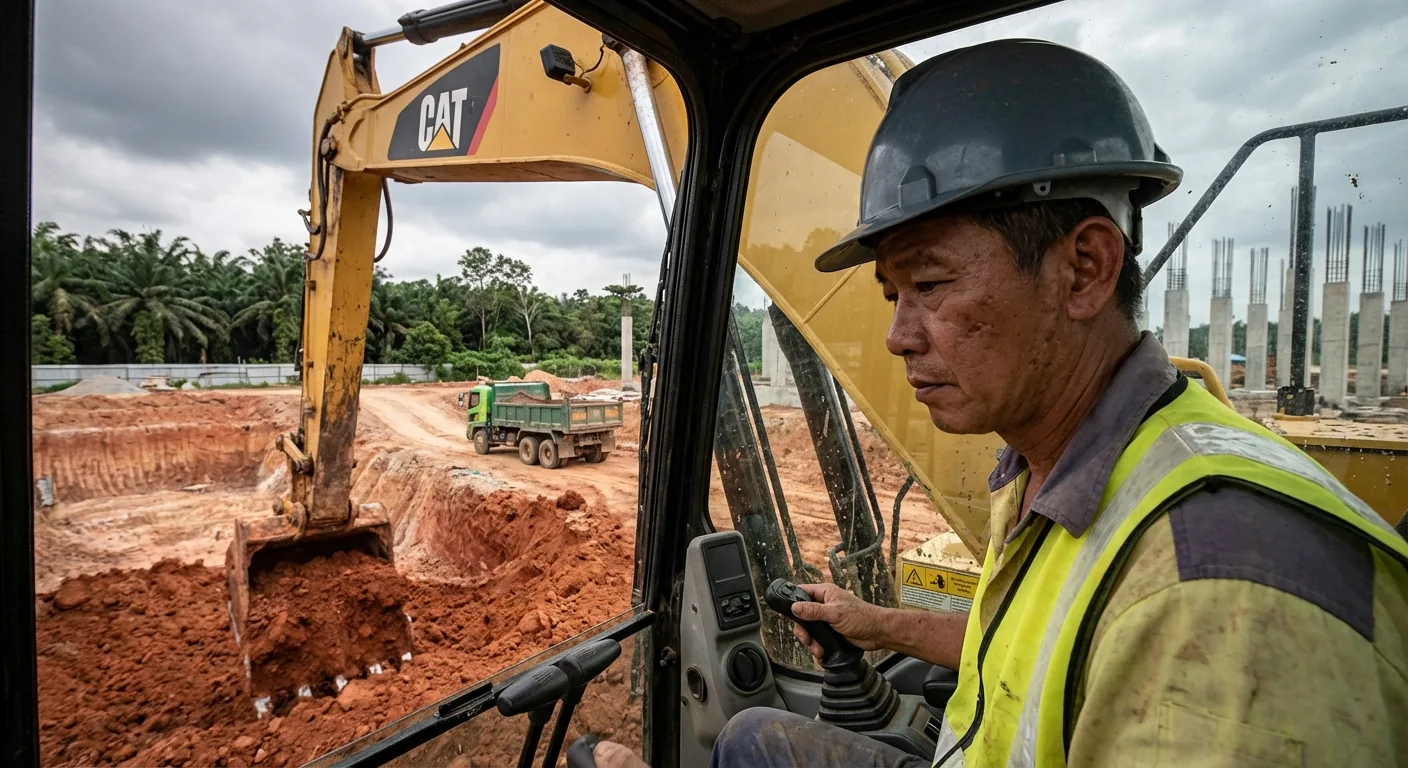
When you rent an excavator with an operator, the rental company sends a trained, CIDB-certified person to run the machine on your site. You point to the work, agree on the scope, and they handle the digging, grading, loading, and tracking. You pay the machine day rate plus an operator add-on, which typically runs RM150–300 per day depending on machine size and job complexity.
Self-operate means you rent the bare machine and supply your own labour. This only makes sense if you — or someone on your crew — already holds valid CIDB certification and has real seat time on that class of excavator. The day rate is lower because you're not paying for the operator, but you take on everything the operator would otherwise handle.
For most one-off jobs in Malaysia, the with-operator option is the default for good reason. It removes the biggest variable — operator skill — and lets you focus on the result rather than the controls.
Cost: what you actually pay
On paper, self-operate looks cheaper because you skip the operator add-on. A standard 7–20 tonne excavator might run RM1,500–2,500 per day for the machine alone, and an operator adds roughly RM150–300 on top. Over a single day, that's a small premium for guaranteed competence.
But the cheaper option is only cheaper if your self-operation is efficient. An under-skilled operator works slower, makes mistakes that need reworking, and risks damaging the machine or surrounding structures — and you may be liable for that damage. A job that a certified operator finishes in two days could stretch to four in inexperienced hands, wiping out the saving.
Where self-operate genuinely pays off is on longer projects where you have your own certified crew already on payroll. If you're running earthworks for weeks and your team is qualified, renting bare machines on a weekly or monthly package can be the more economical route.
Licensing and the CIDB requirement
This is the part many first-time renters miss. In Malaysia, operating heavy machinery like an excavator on a construction site generally requires CIDB certification — the Green Card. You cannot simply hop in and dig because you've watched a few videos.
If you choose with-operator, this is handled for you: every operator we provide is CIDB-certified. If you self-operate, the burden is on you to ensure whoever runs the machine holds valid certification. Running an uncertified operator exposes you to compliance problems and undermines any insurance claim if something goes wrong.
Before deciding to self-operate, confirm in writing who on your team is certified and for which machine class. A Green Card for a mini excavator does not automatically qualify someone for a 20-tonne-plus long reach or an amphibious unit.
Safety, liability and insurance
Excavators are powerful and unforgiving. A trained operator understands swing radius, slope stability, load limits, and how to read soft or unstable ground — exactly the knowledge that prevents tip-overs, strikes on underground utilities, and injuries.
With an operator, much of the operational liability sits with the trained professional, and operator coverage is typically in place — though you should always clarify the exact scope of insurance with the rental company before work starts. Confirm what's covered: the machine, third-party damage, and injury.
Self-operating shifts more of that responsibility onto you. If your operator misjudges a trench wall or clips a structure, the consequences — and the cost — are more likely to land on your side. For anyone without deep excavation experience, the safety case alone usually tips the decision toward hiring with an operator.
Productivity and project fit
A certified operator is productive from the first hour. They know how to position the machine, sequence the dig, and avoid the small errors that slow a job down. On complex work — deep excavation, river dredging with a long reach, or soft-ground digging with an amphibious unit — that experience is not optional, it's the difference between the job getting done safely and not at all.
Self-operate fits a narrower set of situations: long-running projects, repetitive earthmoving, and crews who already operate this machinery daily. If your team digs every week and is fully certified, the bare-machine route gives you flexibility and control over scheduling.
Match the option to the job. A quick drainage trench on a tight residential lot, a one-week demolition, or a single dredging task almost always points to with-operator. A multi-week site clearance with your own qualified team can justify self-operate.
How to decide — a quick checklist
Run through these questions before you book. If you answer no to any of the first three, hiring with an operator is almost certainly the right call.
- Does someone on your crew hold a valid CIDB Green Card for this exact machine class?
- Do they have real, recent seat time on a machine this size — not just on smaller units?
- Is your insurance set up to cover self-operation, including third-party and machine damage?
- Is the job long enough (weeks, not days) that paying your own crew beats the operator add-on?
- Is the work straightforward earthmoving rather than complex digs, dredging, or soft-ground work?
- Can you coordinate transport, loading, and on-site positioning yourself?
Our Verdict
For most renters in Malaysia, hiring the excavator with a CIDB-certified operator is the safer, simpler, and often more economical choice — especially for one-off jobs, tight deadlines, or any complex work like deep excavation, dredging, or soft-ground digging. The operator add-on of roughly RM150–300 per day buys you certified skill, lower liability, and a job done right the first time, with no licensing headache on your side. Self-operate makes sense in one clear scenario: long-running projects where you already have your own CIDB-certified crew and the insurance to back self-operation. In that case the lower bare-machine rate, especially on weekly or monthly packages, can deliver real savings. If you're unsure which way to go, tell us about your job — machine size, duration, and site conditions — over WhatsApp and we'll recommend the setup that fits and send a quote.