Amphibious vs Standard Excavator: Which One Does Your Site Need?
The choice between an amphibious vs standard excavator almost always comes down to one thing: can the ground actually hold the machine? Pick wrong and you either pay a premium you didn't need, or you sink a standard excavator in a swamp and lose days getting it out. This guide walks through the terrain, mobility, cost, and the point where soft ground stops being a preference and becomes a hard requirement.
At a Glance
| Amphibious | Standard | |
|---|---|---|
| Best for terrain | Swamp, marsh, lake, riverbank, coastal mud, soft peat, waterlogged ground | Firm soil, compacted earth, construction sites, roads, hardstanding |
| Undercarriage | Sealed pontoon floats with track shoes — spreads weight, floats on water | Steel or rubber tracks on solid ground — needs bearing capacity |
| Ground pressure | Very low — designed not to sink in soft or saturated ground | Higher — concentrated load that soft ground cannot support |
| Works on / in water | Yes — can float and work in shallow water and soft mud | No — must stay on firm, dry, load-bearing ground |
| Typical day rate | RM3,500–6,000/day | RM1,500–2,500/day (standard 7–20 tonne) |
| Mobilisation | More planning — specialised low-loader, harder access to remote wetland sites | Straightforward — standard transport, same-day / next-day in most areas |
| Travel speed on land | Slow — pontoons are built for flotation, not ground travel | Faster and more manoeuvrable on firm ground |
| Common jobs | River dredging, swamp clearing, pond and lake works, coastal reclamation | Construction, demolition, earthworks, foundation digging, trenching |
| Availability | Specialised fleet — fewer units, book earlier | Widely available across all 16 states |
The Real Question: Will the Ground Hold the Machine?
Most people frame this as amphibious vs standard excavator, but the decision is really about ground-bearing capacity. A standard excavator concentrates a lot of weight onto its tracks. On firm soil, compacted earth, or a prepared construction site, that's no problem. On soft, saturated, or waterlogged ground, that same weight has nowhere to go — and the machine sinks.
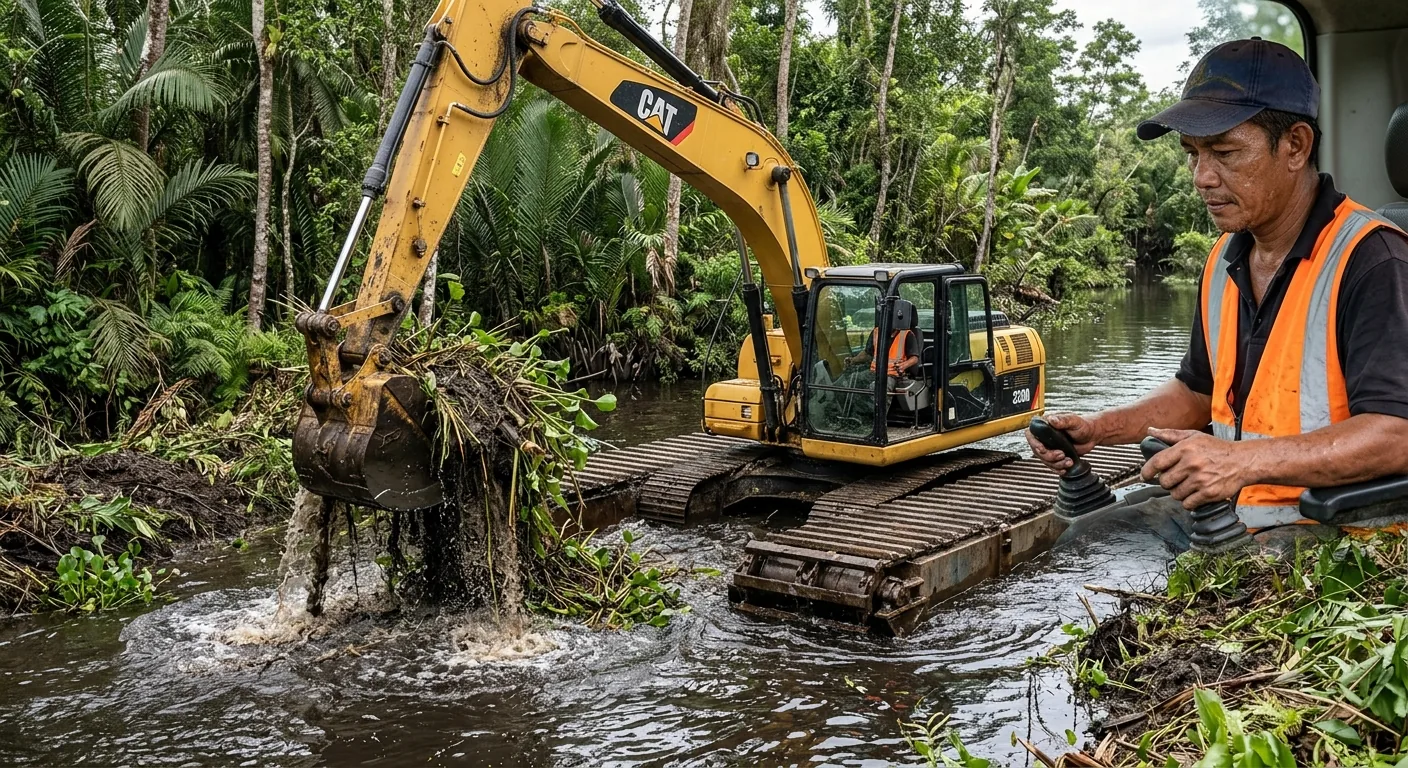
An amphibious excavator solves this with a sealed pontoon undercarriage. The pontoons spread the machine's weight over a much larger area and provide enough buoyancy to float on water and stay on top of soft mud. That's the whole point of the design: it goes where a standard machine physically cannot.
So before comparing price or speed, walk your site. If a person sinks past their ankles, if there's standing water, or if it's reclaimed coastal land or peat, you're likely looking at an amphibious job. If the ground is firm enough to drive a lorry across, a standard excavator will almost always do the work for far less.
Where Each Machine Earns Its Keep
A standard excavator (typically 7–20 tonne) is the workhorse for the vast majority of jobs in Malaysia — construction, demolition, earthworks, foundations, trenching, and general site clearing. It's faster on firm ground, more manoeuvrable, widely available, and far cheaper to hire and mobilise. If your site is dry and load-bearing, this is the obvious pick.
An amphibious excavator is a specialist tool for water and soft-ground work. It comes into its own on river dredging, swamp and marsh clearing, pond and lake desilting, riverbank maintenance, coastal reclamation, and any earthwork where part of the machine sits in water or saturated mud.
The mistake to avoid is putting a standard machine on amphibious terrain to save money. A bogged-down excavator can take days and a recovery crew to extract, and the lost time usually dwarfs whatever you saved on the day rate. Match the machine to the ground, not to the budget.
A Quick Ground-Check Before You Decide
You don't need a soil report to make the first call. Walk the site and look for the signs that push a job from standard into amphibious territory:
- Standing water, or ground that stays wet long after rain
- Soft mud, peat, or ground where you sink past your ankles
- Riverbanks, ponds, lakes, or drains where the machine must work in or over water
- Reclaimed coastal land, mangrove, or swamp
- Access routes that are themselves soft — a standard machine may sink just getting to the work area
- Previous attempts where a tracked machine got stuck or bogged down
Cost: Why Amphibious Costs More — and When It's Worth It
There's a real gap in price. A standard excavator typically runs RM1,500–2,500/day, while an amphibious unit runs RM3,500–6,000/day. The difference reflects the specialised pontoon undercarriage, the smaller pool of machines available, and the extra planning that wetland and water access usually requires.
That premium is worth it only when the terrain demands it. On firm ground, paying amphibious rates buys you nothing — a standard machine does the same work faster and cheaper. But on genuine soft ground, the amphibious unit isn't the expensive option, it's the only option that finishes the job. Add weekly or monthly packages for longer dredging or reclamation works and the per-day cost comes down.
Both options carry the same supporting costs: CIDB-certified (Green Card) operators at roughly RM150–300/day, and mobilisation from around RM500 in the Klang Valley, charged by distance elsewhere. Amphibious mobilisation tends to need more planning because remote wetland sites are harder to reach with a low-loader.
Mobility, Access, and Lead Time
On land, a standard excavator is faster and more manoeuvrable — it tracks around a site easily and gets in and out quickly. An amphibious machine trades that land speed for flotation; the pontoons are built to stay on top of soft ground and water, not to travel fast across a dry yard.
Access planning matters more for amphibious work. The site is often remote — a riverbank, a swamp, a coastal stretch — and getting the machine there can take more coordination than the dig itself. It's worth confirming delivery access early so there are no surprises on the day.
Lead time differs too. Standard excavators are widely stocked across all 16 states and we can often arrange same-day or next-day delivery. The amphibious fleet is smaller and in demand, so for a swamp, dredging, or reclamation job it's best to book ahead and lock in dates.
Still Not Sure? Send Us the Site Details
If you can describe the ground — or better, send a photo or video over WhatsApp — we can tell you in minutes whether the job needs an amphibious unit or whether a standard excavator will handle it. A short conversation up front is far cheaper than mobilising the wrong machine.
Tell us the location, what you're digging or clearing, and how wet the ground is. We'll recommend the right class of machine, a CIDB-certified operator if you need one, and give you a clear quote with mobilisation costed for your area. No pressure, just a straight answer on what fits.
Our Verdict
For most jobs in Malaysia, a standard excavator is the right call — it's cheaper, faster on firm ground, widely available, and handles the bulk of construction, demolition, and earthwork tasks. Choose an amphibious excavator only when the terrain forces your hand: swamp, marsh, riverbank, lake, coastal mud, peat, or any work that happens in or over water. The deciding factor is never preference or budget — it's whether the ground can physically bear a standard machine. If it can, go standard and save the premium. If it can't, the amphibious unit isn't the expensive choice, it's the one that actually finishes the job without getting bogged down. When in doubt, send us a photo of the site over WhatsApp and we'll tell you which one you need.