Mini Excavator Malaysia: The Complete Guide (1–5 Tonne)
A mini excavator is the machine that gets into the spaces a full-size unit can't — narrow side passages, finished gardens, and indoor demolition. This guide covers what a 1–5 tonne mini actually does well, the jobs it's built for, what it costs to rent, and how to know when a mini is the right call versus stepping up to a standard unit.
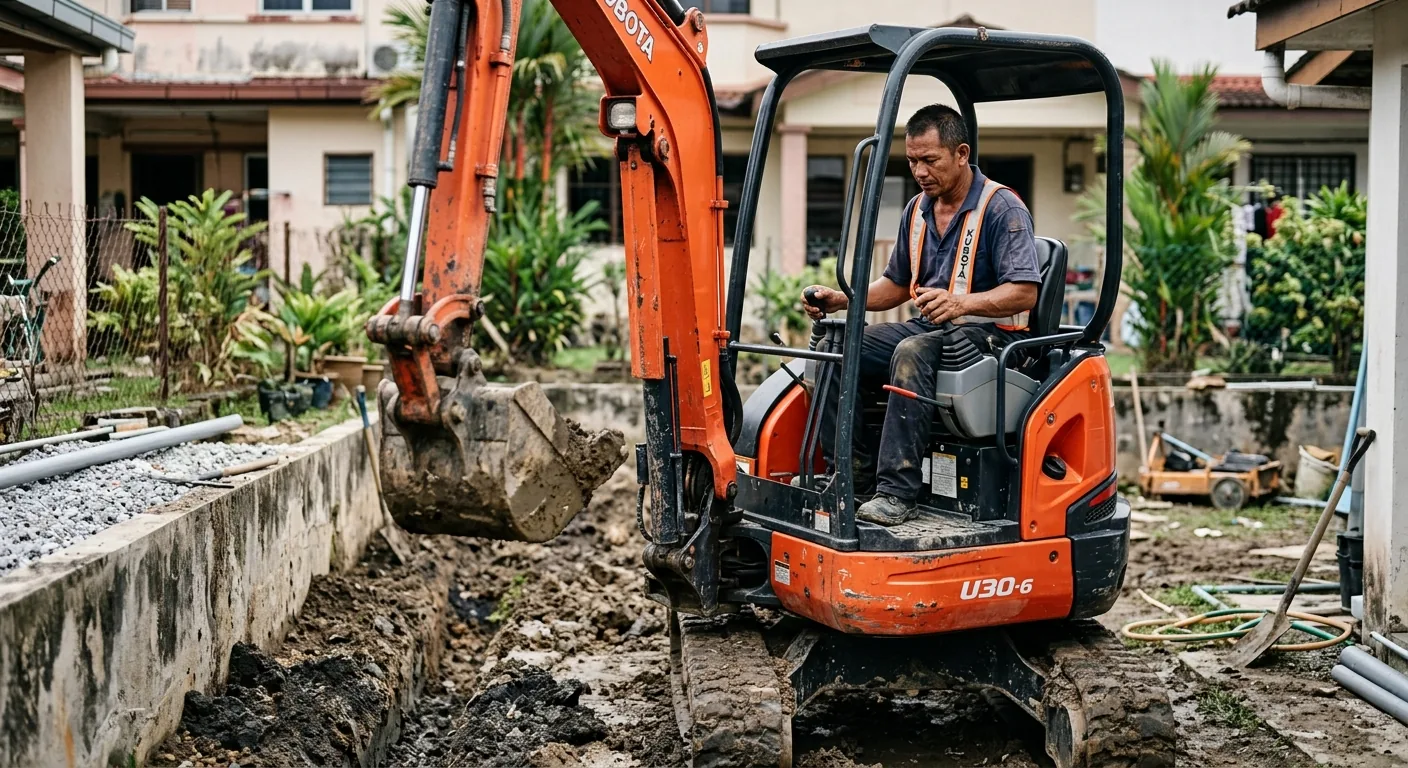
What a mini excavator actually is
A mini excavator is a compact tracked digger in the 1 to 5 tonne weight class. The number refers to operating weight, and it tells you most of what you need to know: a 1.5 tonne machine is small enough to roll through a standard gate opening, while a 5 tonne unit starts to approach the dig depth and reach of a small standard excavator.
What sets a mini apart is the combination of a short tail swing, rubber tracks, and a narrow track width. Rubber tracks mean the machine can drive across paving, a finished driveway, or a lawn without tearing it up the way steel tracks would. The compact footprint lets it work close to walls, fences, and existing structures where a larger machine simply won't fit.
In the Malaysian market, mini excavators are the workhorse for residential and light commercial jobs — the projects where access is tight and the volume of soil to move is moderate rather than massive.
Why tight access is the mini's biggest advantage
The single biggest reason to choose a mini is access. Many Malaysian residential lots have a side passage of barely a metre between the house and the boundary wall, and that is exactly the kind of gap a sub-2 tonne machine is designed to squeeze through. Once it's in the back, it can do the work of ten men with shovels.
Tail swing matters here too. A zero or near-zero tail swing model keeps its rear within the width of the tracks as it rotates, so the operator can dig hard against a wall without the counterweight clipping anything behind. That's the difference between finishing a job cleanly and leaving an awkward strip to be dug by hand.
Weight also keeps options open. A lighter mini can be driven onto a suspended slab, a podium deck, or even inside a building for indoor demolition — situations where the floor loading of a heavier machine would be a real problem. Always confirm the structure can take the load, but the mini at least makes the conversation possible.
Best jobs for a mini excavator
A mini earns its keep on jobs where precision and access matter more than raw production. These are the tasks it's genuinely well suited to:
If your job is on this list, a mini is very likely the right tool. Where it falls short is bulk earthmoving — moving large volumes of soil over a big open site is slow work for a small bucket, and that's when a standard unit pays for itself.
- Drainage and trenching — digging trenches for stormwater, perimeter drains, and French drains at a controlled, accurate depth.
- Landscaping — pool excavation, levelling, retaining wall footings, tree and stump removal, and ground prep in finished gardens.
- Piping and utilities — laying water, sewer, gas, and conduit runs where the trench needs to follow a precise line.
- Footings and foundations — digging pad and strip footings for extensions, sheds, and small structures.
- Indoor and confined demolition — breaking up old slabs or interior concrete where headroom and access rule out anything bigger.
- Tight residential sites — backyard work, side-passage access, and built-up areas where a standard machine can't get in.
What it costs to rent a mini excavator in Malaysia
A mini excavator typically rents from RM800 to RM1,200 per day. Where you land in that range depends on the size of the machine, whether you take it with an operator, how long you keep it, and where the site is.
Hiring with a CIDB-certified operator adds roughly RM150 to RM300 a day. For most clients this is money well spent — a skilled operator works faster, digs more accurately, and reduces the risk of striking a service or over-digging. Renting bare (machine only) makes sense only if you have your own competent, ticketed operator.
Two other line items to plan for. Mobilisation, meaning delivery and pickup of the machine on a lorry, starts from around RM500 in the Klang Valley and scales with distance for sites further out — so factor in your location. And if your job runs beyond a few days, ask about weekly and monthly packages, which bring the effective daily rate down considerably and are the better value for any sustained project.
Mini vs standard excavator: when to size up
The honest answer is that a mini is the right call until the volume of work outgrows it. If access is your main constraint — narrow entry, finished surfaces, working indoors or close to structures — the mini wins almost every time, because a standard machine that can't reach the work is worth nothing on site.
But once you're on an open site with serious volume to move, the maths flips. A standard excavator in the 7 to 20 tonne class digs deeper, reaches further, and shifts far more soil per hour. On a large earthworks or construction job, its higher day rate is more than offset by finishing in a fraction of the time. Trying to clear a big site with a mini bucket is slow and, in the end, more expensive.
A simple way to decide: if you keep asking whether the machine will physically fit, rent a mini. If you keep asking how fast you can move the dirt, you've outgrown it — look at a standard unit. When you're genuinely unsure, send us the site details over WhatsApp and we'll recommend the right size rather than oversell you a machine you don't need.
How to get the right mini for your job
Before you book, gather a few details and it'll make the whole process quicker. Know your tightest access width, since that determines the largest machine that can physically get to the work. Have a rough idea of dig depth and the type of ground — soft soil, hardpan, or rock changes how the job runs. And note your dates, because same-day and next-day delivery is usually possible but firming up the schedule helps us guarantee it.
From there it's straightforward. Tell us the job, the location, and your dates, and we'll confirm machine size, whether you want an operator, the delivery cost to your site, and the all-in price. We cover all 16 states, so wherever the project is in Malaysia, there's a unit and a route to get it there.
The fastest way to a firm quote is a quick WhatsApp message with your site details. We'll come back with a clear price and the right machine — no guesswork, no pressure.