Amphibious Excavator: What It Does and When You Need One
An amphibious excavator can work where a normal machine would sink. By swapping steel tracks for sealed floating pontoons, it operates on swamp, peat, mud, and shallow water that standard excavators simply cannot reach. Here is how the floating undercarriage works, the jobs that genuinely need one, and what to think about before you rent.
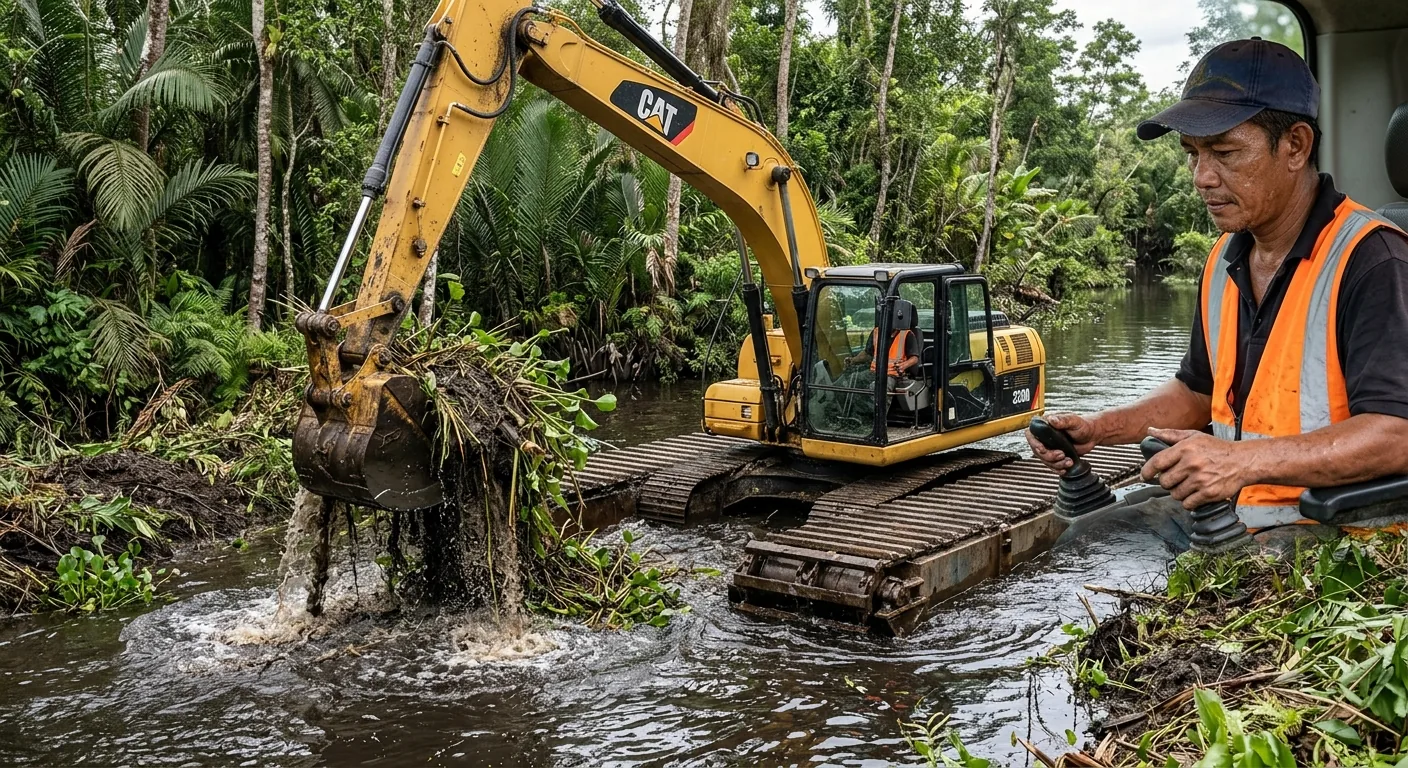
What an amphibious excavator actually is
An amphibious excavator is a standard excavator upper body — the cab, engine, boom, arm, and bucket — mounted on a pontoon undercarriage instead of conventional steel crawler tracks. The pontoons are large, sealed, hollow steel floats fitted with track shoes on the outside. They give the machine enough buoyancy to sit on top of soft, waterlogged ground rather than sinking into it.
The result is a machine that does the same digging, dredging, and lifting work as a regular excavator, but in places where the ground will not hold weight. Think wetlands, retention ponds, river edges, and soft peat soil — terrain that would swallow a normal 20-tonne machine within minutes.
Because the pontoons are wide and displace a lot of water, the machine spreads its weight over a much larger area. This dramatically lowers ground pressure, which is the whole reason it can float or 'walk' across surfaces that look impossible to work on.
How the floating pontoon undercarriage works
The two pontoons run along each side of the machine in place of normal tracks. Each one is a watertight steel chamber, so even when the excavator is partly submerged, the air sealed inside keeps it afloat. The track shoes wrapped around the pontoons let the machine drive itself forward and back, and pivot, the same way crawler tracks do on land.
On shallow ground the machine moves by gripping the soil or pond bed with those shoes. In deeper water, many amphibious units add a pair of spud poles — vertical legs at the rear that drop down to anchor the machine while it digs, so it does not drift while the operator works.
For genuinely deep or open water, some pontoons can be fitted with side floats and propulsion attachments to extend reach and stability further. The exact setup depends on the job, so it is worth telling us the water depth and ground conditions up front so the right configuration goes out to site.
The jobs that genuinely need an amphibious excavator
You only need an amphibious machine when a standard or long reach excavator cannot safely reach or support itself. For firm ground beside the water, a long reach unit working from the bank is often cheaper and faster. The amphibious option earns its keep when the work is on or in the soft ground itself.
Typical jobs where it is the right tool:
- Swamp and wetland clearing — removing silt, vegetation, and debris in marshland and mangrove edges.
- Lake and retention pond maintenance — dredging accumulated mud to restore depth and water capacity.
- Peat soil works — operating on soft, spongy ground common in parts of Malaysia where machines otherwise sink.
- River and drainage dredging — deepening channels and clearing blockages from within the waterway.
- Coastal and estuary works — working soft, tidal ground near the shoreline.
- Stormwater and irrigation ponds — desilting and reshaping ponds on plantations and developments.
Amphibious vs long reach: which one do you need?
These two machines often get confused because both deal with water and difficult access, but they solve different problems. A long reach excavator has an extended boom and arm — typically reaching well past a standard machine — and works from solid ground at the edge of a pond, river, or slope. The machine itself stays on firm footing.
An amphibious excavator goes the other way: it puts the whole machine onto the soft ground or water and works from there. So the question is simple — can you reach the work from a stable bank? If yes, long reach is usually the better value. If the ground itself is too soft to stand on, or the work is too far from any firm edge, you need amphibious.
Sometimes a project uses both: a long reach machine handles the edges from the bank while an amphibious unit reaches the centre of a large pond or swamp. If you are unsure, send us a photo of the site and a rough description of the ground, and we will tell you honestly which machine fits.
What it costs to rent in Malaysia
Amphibious excavators are specialised machines, so they sit at the top of the rental range. Expect rates from around RM3,500 to RM6,000 per day, depending on the size of the machine, the pontoon configuration, and how long you need it. Weekly and monthly packages bring the daily cost down considerably and make sense for any dredging or wetland project that runs more than a few days.
Most of our machines come with a CIDB-certified (Green Card) operator. Amphibious work is not something to hand to an inexperienced hand — reading water depth, managing the spud poles, and keeping the machine stable takes real skill — so an operator add-on of roughly RM150 to RM300 per day is money well spent here.
On top of the rental and operator, budget for mobilisation. Delivery starts from around RM500 in the Klang Valley and is distance-based elsewhere, and amphibious machines may need a low-loader and assembly on site, so tell us the location early and we will give you an all-in figure rather than surprises later.
Planning your amphibious rental
A little site information goes a long way to getting the right machine and an accurate quote. Before you message us, it helps to know the water depth, whether the ground is peat, mud, silt, or sand, how far the work is from a firm access point, and roughly how many days the job will take.
Access for delivery matters too. The machine often arrives on a low-loader and may be partly assembled on site, so we need to know whether a lorry can get close to the launch point. If access is tight, we will work out the safest way to get the machine in.
We offer same-day or next-day delivery where the schedule allows, and we cover all 16 states. The fastest way to get a real quote is to WhatsApp us a short description of the site — water depth, ground type, location, and duration — and we will recommend the right configuration and price the same day.