How to Choose Excavator Size: A Simple Decision Framework
Picking the wrong excavator size is one of the most common — and most expensive — mistakes on a job site. Rent too small and the work drags on; rent too big and it can't fit through the gate. This guide gives you a simple framework for matching tonnage to your job, your access, and your ground conditions.
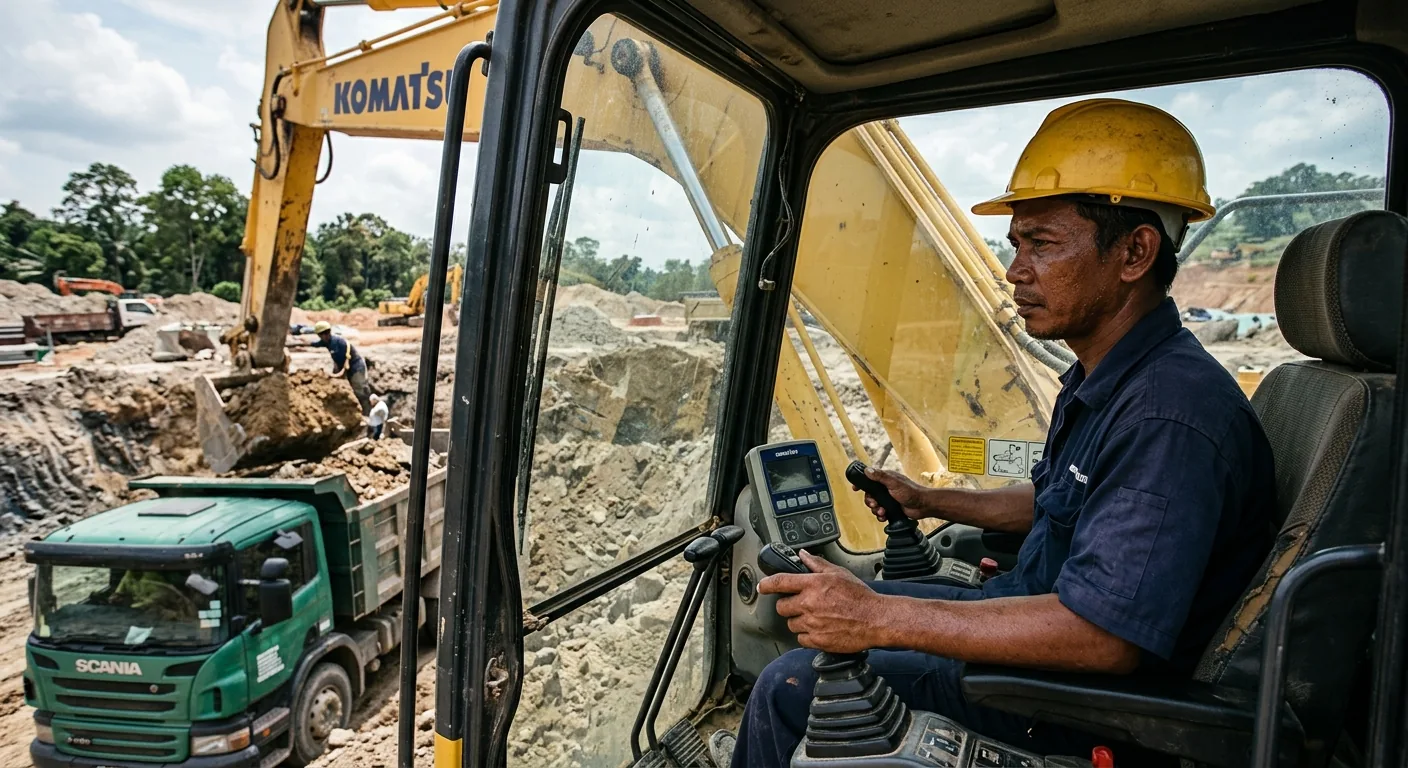
Start With the Job, Not the Machine
Before you compare machines, get clear on what the excavator actually has to do. A 2-tonne mini that's perfect for a drainage trench in a housing lot is useless for clearing a half-acre site, and a 20-tonne standard machine will tear up a finished garden it was never meant to enter.
The honest way to figure out how to choose excavator size is to work backwards from three things: the task, the space you have to work in, and the conditions underfoot. Tonnage is the headline number everyone fixates on, but it's really just a shorthand for digging force, reach, and how much ground the machine occupies.
If you can describe the job in one plain sentence — "dig a 3-metre-deep foundation trench in clay soil, access through a 1.8-metre side gate" — you're already most of the way to the right answer. The sections below turn that sentence into a tonnage.
Match Tonnage to the Type of Work
Excavators in Malaysia are usually grouped by weight class, and each class is built for a different scale of work. Getting this match right is the single biggest factor in finishing on time and on budget.
Mini excavators (1–5 tonne) are the go-to for tight, light work: drainage, landscaping, swimming pool digs, utility and piping trenches, and anything inside a built-up residential area. They're small enough to fit through standard gates and gentle enough not to wreck driveways or paving. Day rates typically run from RM800–1,200.
Standard excavators (7–20 tonne) are the workhorses of general construction — earthworks, demolition, site clearing, foundation digging, and loading trucks. If you're moving real volume on an open site, this is almost always the right class, typically RM1,500–2,500 a day.
Long reach excavators (20 tonne+) and amphibious excavators are specialist tools. Long reach machines, with their extended arms, handle river dredging, deep excavation, and bridge or slope work where you need to dig far from where the machine sits. Amphibious excavators ride on pontoon undercarriages built for swamp, lake, coastal, and very soft ground. You only need these for the specific conditions they're designed for — but when you do, nothing else will work.
- Mini (1–5t): drainage, landscaping, piping, tight residential access
- Standard (7–20t): construction, demolition, earthworks, truck loading
- Long reach (20t+): river dredging, deep digs, bridge and slope works
- Amphibious: swamp, lake, coastal, and soft-ground sites
Measure Your Site Access First
Access is where most size mistakes happen. A machine that's perfect on paper is worthless if it can't physically reach the dig area. Before you book anything, measure the narrowest point on the route in — a side gate, a corridor between buildings, a soft garden path, or a low car porch.
As a rough guide, a small mini excavator can squeeze through gaps a little under 1 metre wide, while most minis need around 1 to 1.5 metres. Standard machines need a few metres of clearance and a route that can take their weight without cracking. Don't forget overhead obstacles too: low cables, eaves, and car porches all limit machine height.
If access is genuinely tight, size down — a slightly smaller machine that can actually reach the work beats a bigger one stuck at the gate. When you're unsure, send us the dimensions on WhatsApp and we'll tell you straight whether a machine fits before it leaves the yard. That five-minute check saves a wasted mobilisation fee.
Read the Ground Conditions
The soil and ground decide how much machine you need and whether it can move at all. Hard, compacted, or rocky ground needs more breaking force, which pushes you toward a heavier standard excavator or an attachment like a breaker. Soft clay and loose fill are easier to dig but can swallow a heavy machine.
Ground bearing is the part people underestimate. A 20-tonne machine on soft, waterlogged ground will sink and bog down — that's exactly the situation amphibious excavators on pontoon undercarriages are built for. If your site is swampy, beside a lake, coastal, or freshly reclaimed, the conditions, not the task, dictate the machine.
Wet weather changes the calculation too. In the Malaysian rainy season, ground that carried a standard excavator in March can turn into a bog by November. If you're working through the monsoon on low-lying land, factor that in early rather than getting a machine stuck halfway through the job.
Account for Dig Depth and Reach
Two jobs of the same scale can need very different machines purely because of depth and reach. Every excavator has a maximum dig depth and a maximum reach, and if your trench is deeper or further than the machine can manage, you'll be left finishing by hand or — worse — renting a second machine.
A mini excavator typically reaches a few metres down, which covers most drainage, piping, and shallow foundation work. Standard machines dig considerably deeper and are the right pick for proper foundations, basements, and pile caps. When you need to dig deep or reach across an obstacle — over a riverbank, into a pond, or down a slope — that's the job for a long reach excavator.
Always give yourself a margin. If your design calls for a 4-metre dig, don't pick a machine rated to exactly 4 metres; you want comfortable headroom so the operator isn't working at the machine's absolute limit. Tell us your target depth and reach when you enquire and we'll match a machine with the right envelope.
A Quick Which-Size-for-Which-Job Guide
Here's the framework boiled down to a fast reference. Use it as a starting point, then confirm the details — access width, depth, ground — with us before booking.
Drainage, landscaping, pool digs, or piping in a residential area: a mini excavator (1–5 tonne). General construction, demolition, earthworks, or site clearing on an open site: a standard excavator (7–20 tonne). Deep excavation, river dredging, or bridge and slope works: a long reach excavator (20 tonne+). Swamp, lake, coastal, or very soft ground: an amphibious excavator.
One more decision that affects size and cost: whether you need an operator. Our operators are CIDB-certified (Green Card), and the add-on typically runs RM150–300 a day. For anything beyond the simplest mini work, a skilled operator finishes faster and safer, which often costs less overall than struggling with the wrong setup. If you're renting for more than a few days, ask about weekly and monthly packages — they're better value than stacking daily rates.
- Tight residential / drainage / landscaping → Mini (1–5t)
- General construction / earthworks / demolition → Standard (7–20t)
- Deep digs / dredging / bridge works → Long reach (20t+)
- Swamp / lake / coastal / soft ground → Amphibious
- Unsure? Send us the job details — we'll size it for you