Excavator Attachments Explained: Match the Tool to the Job
An excavator is only as useful as the tool on the end of its arm. The machine swings the power; the attachment decides what work actually gets done. This guide walks through the main excavator attachments, what each one is built for, and how to match the right tool to your job so you hire once and finish clean.
Why the attachment matters more than the machine
Most people choosing an excavator focus on the size — mini, standard, long reach. That matters, but the attachment on the boom is what actually does the work. A 20-tonne excavator with a general-purpose digging bucket and the same machine fitted with a hydraulic breaker are, for practical purposes, two different tools on site.
Getting the attachment right the first time saves real money. The wrong bucket means you grade the slope twice. A missing breaker means the machine sits idle while someone hires a separate compressor and jackhammer crew. Knowing what each excavator attachment is for lets you spec the job properly before the machine arrives.
Most attachments mount via a quick coupler, so a single excavator can switch between several tools in a day. When you tell us the job, we match the machine size and the attachments together — that pairing is the part that decides whether your day runs smoothly.
Buckets: digging, grading and rock
The bucket is the default attachment and the one you'll use most. But "bucket" covers several distinct types, and using the wrong one slows everything down.
A digging (general-purpose) bucket is the workhorse — narrow, with teeth, built to penetrate and dig trenches, footings and foundations in normal soil. A grading (ditching or mud) bucket is wide, smooth and usually toothless, made for finishing slopes, levelling ground, cleaning ditches and shaping the final surface. A rock (heavy-duty) bucket has reinforced sides and hardened teeth for breaking into hard, stony or compacted ground where a standard bucket would just bounce or wear out fast.
A simple rule: dig with a digging bucket, finish with a grading bucket. If your site is rocky or you're working compacted laterite, ask for a rock bucket up front so you're not chewing through teeth on a tool that wasn't built for it.
Hydraulic breaker (hammer): for rock and concrete
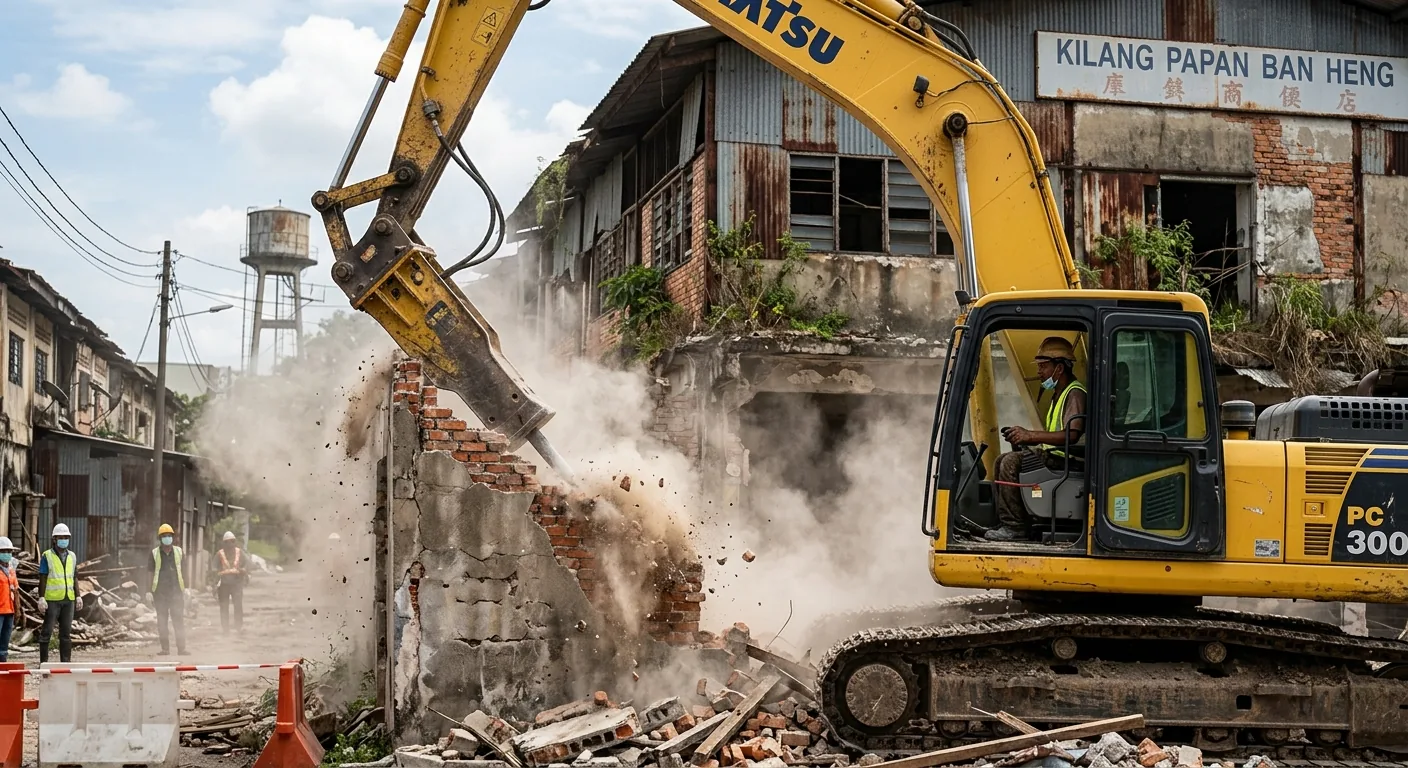
The hydraulic breaker — most people just call it the hammer — is a powered chisel that pounds through material a bucket can't dig. It's the go-to attachment for breaking rock, demolishing concrete slabs and foundations, removing old road surfaces, and trenching through hard ground.
Breakers are sized to the carrier machine. A small breaker on a mini excavator handles light demolition, kerbs and thin slabs; a heavy breaker on a standard 20-tonne machine takes on thick reinforced concrete and solid rock. Matching breaker weight to machine weight matters — an oversized hammer can stress a small excavator, while an undersized one just wastes time.
If your job involves any demolition, rock excavation or hard-surface removal, plan for the breaker from the start. It's a common reason a project stalls: the digging goes fine until it hits rock, and then there's nothing on site to deal with it.
Auger, grapple, ripper and compactor
Beyond buckets and breakers, a handful of specialist attachments cover specific tasks. Knowing they exist often changes how you plan the job.
An auger is a large drill bit that bores clean, vertical holes — used for fence posts, sign poles, foundation piers, tree planting and pile holes. Auger bits come in different diameters, so tell us the hole size you need. A grapple is a hydraulic claw for gripping and lifting irregular loads: logs, tree stumps, demolition debris, rocks and scrap. It's far safer and faster than trying to scoop awkward material with a bucket.
A ripper is a single heavy tooth (sometimes three) that tears into hard, compacted ground, rock seams and root masses — loosening material so a bucket can then clear it. A compactor (plate or vibratory) does the opposite job: it presses and vibrates soil, backfill or trench bottoms firm, useful where a roller can't reach. Between them, these tools handle the loosening-and-firming work that buckets alone can't.
How to match the attachment to the job
The fastest way to spec a hire is to start from the task, not the machine. Describe what you're actually doing and the right attachment usually picks itself.
Here's a quick reference for the most common jobs:
- Trenching and digging footings in normal soil — digging bucket
- Levelling, finishing slopes, cleaning drains — grading bucket
- Hard, stony or compacted ground — rock bucket or ripper
- Breaking concrete, rock or old road surfaces — hydraulic breaker (hammer)
- Drilling post holes, piers or planting holes — auger
- Lifting logs, stumps, debris or scrap — grapple
- Compacting backfill, trench bottoms or soil in tight spots — compactor
Matching the attachment to the machine size
An attachment only works if the excavator can carry and power it. A mini excavator (1–5 tonne) takes small buckets, light breakers and augers — ideal for tight access, drainage, landscaping and piping. A standard excavator (7–20 tonne) runs the full range of buckets, heavier breakers, rippers and grapples for construction, demolition and earthworks.
Bigger and specialist machines change what's possible too. A long reach excavator (20 tonne and up) carries buckets and breakers on an extended arm for river dredging, deep excavation and bridge works. An amphibious excavator, on its pontoon undercarriage, works swamp, lake, coastal and soft ground that would swallow a normal machine — typically paired with grading and digging buckets for dredging and clearing.
When you send through your job, we match three things at once: the machine size for the access and reach, the attachments for the actual work, and a CIDB-certified operator to run it properly. Operator add-on runs from around RM150–300/day, with same-day or next-day delivery and better-value weekly and monthly packages. Tell us the site and the task on WhatsApp and we'll quote the right combination.